Why Puzzles Are the Perfect Travel Companion

Every journey comes with pockets of waiting. A puzzle book turns that time into something genuinely rewarding.
The boarding announcement has just been called. You find your seat, buckle in, and within thirty seconds the screen is out. It is almost automatic now, this reflex of reaching for a phone or tablet the moment stillness arrives. Airports, train platforms, waiting rooms — every pocket of transition in modern travel has been quietly colonised by the scroll. And while the screen promises entertainment, what it usually delivers is a low-grade restlessness, the kind that leaves you more drained when you arrive than when you left.
There is a better way to spend those in-between hours, and it fits in your carry-on bag. Puzzle books have been the quiet companion of thoughtful travellers for generations, and the reasons they work so well on the road go deeper than simple entertainment. A puzzle gives your mind something real to hold onto. It anchors your attention, calms the nervous system, and transforms dead time into something genuinely satisfying. Whether you are crossing a continent or riding the bus across town, a puzzle book turns the journey into an experience worth having.
The Problem with Screens on the Go
Most people do not think of their phone as stressful. It is just there, always available, always offering something. But the research tells a different story. A randomised controlled trial published in BMC Medicine found that reducing daily screen time led to meaningful improvements in depressive symptoms, stress, insomnia, and overall wellbeing among participants. The more hours devoted to passive scrolling, the greater the toll on mood and mental clarity.
Travel amplifies this effect. Airports and long flights already carry their own low-level stress: tight schedules, unfamiliar environments, disrupted sleep. Stacking several hours of screen time on top of an already taxed nervous system rarely ends in genuine rest. Many travellers arrive at their destination feeling oddly flat, despite having done nothing but sit and swipe. The screen was always on, but the mind was never quite off.
What Happens to Your Brain When You Puzzle on the Go
When you open a puzzle book on a plane or train, something different starts happening in the brain. Instead of passively receiving content, you are actively generating it. You are searching, comparing, testing, discarding, and trying again. This kind of focused engagement activates the prefrontal cortex, the part of the brain responsible for reasoning and attention control, in a way that scrolling simply does not.
Research published in PMC examining puzzle-style games found that playing reduced salivary cortisol and alpha-amylase, two established biological markers of stress, while simultaneously increasing sustained attention and overall mental health scores. In other words, puzzling does not just feel calming. It produces measurable physiological calm, shifting the brain and body into a quieter, more focused state.
This connects to a broader picture of what mind-engaging leisure activities do for wellbeing. A longitudinal study published in Frontiers in Public Health found that activities such as word and number games were positively associated with reduced depressive symptoms and a lower risk of mortality over a six-year period. The key ingredient was not duration but quality of engagement. Even short sessions of focused mental activity, the kind that travel naturally provides, carry real benefit.
The experience of this is something most puzzle solvers know intuitively. There is a particular quality to the focus that a good puzzle produces. The noise of the cabin fades. The announcements blur into the background. For a stretch of time, there is only the grid, the clue, or the next missing number. It is not quite meditation, but it shares something with it: a voluntary narrowing of attention that produces genuine rest.
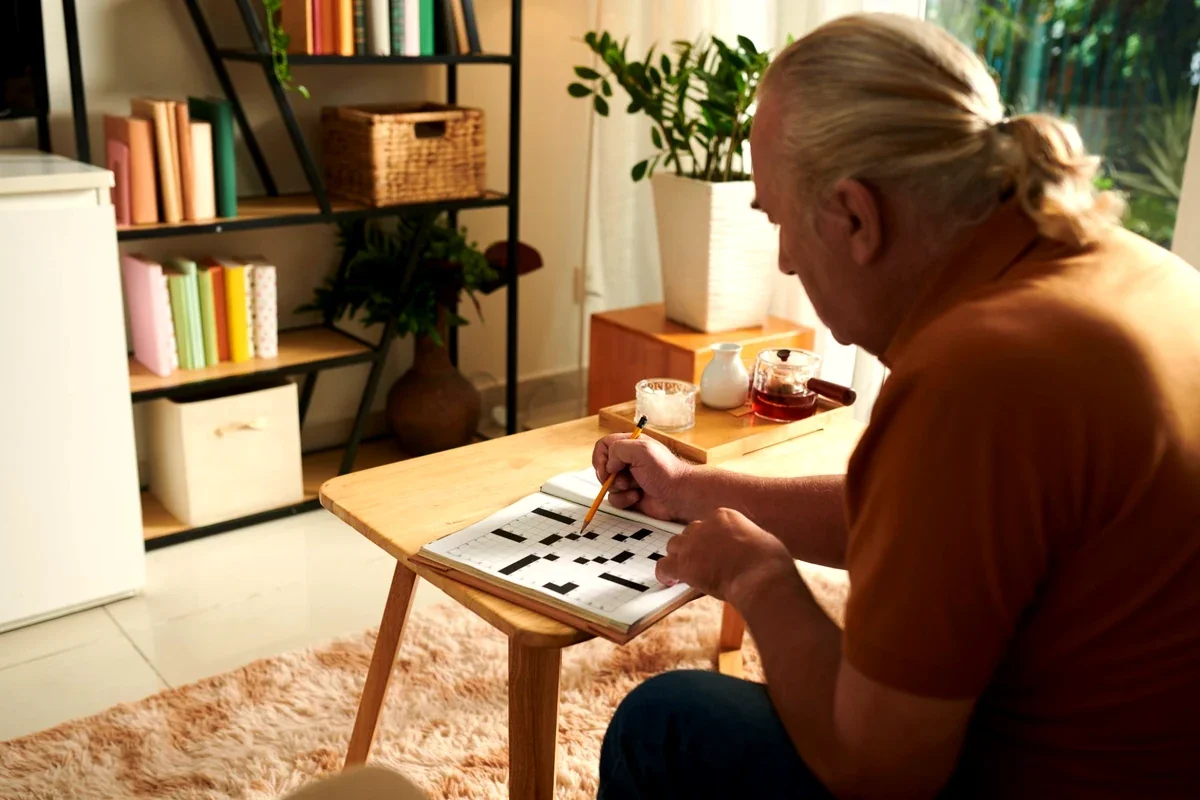
Puzzle solving asks for your full attention — and rewards it with a rare, satisfying sense of mental calm.
The Right Puzzle for Every Kind of Journey
One of the most practical arguments for puzzle books as travel companions is how well they scale to the time and energy available. Not every journey is a transatlantic flight. Some are a twenty-minute commute or an hour in an airport lounge. Puzzle books flex to fit all of them.
For short bursts of time, word searches are ideal. They require no prior knowledge and carry no pressure. You can pick one up, make progress, and set it down again without losing momentum. They train visual scanning and pattern recognition quietly in the background, and they leave you feeling pleasantly settled rather than mentally depleted.
For longer journeys, Sudoku and number-based puzzles like Kakuro reward deeper concentration. These are puzzles that benefit from an uninterrupted block of time, the kind that a long flight naturally provides. The logical structure of a Sudoku grid draws the mind forward steadily, creating the kind of absorbed focus that makes four hours feel like one. Crosswords occupy a middle ground, blending vocabulary, memory, and lateral thinking into something that can fill ten minutes or two hours depending on how deep you want to go.
The physical format matters too. A puzzle book needs no battery, no Wi-Fi connection, and no charging cable. It works at altitude, in tunnels, and in the middle of nowhere. It does not dim when the sun hits it, and it never asks you to update its software. There is something quietly liberating about a tool that simply works, without any of the overhead that screens demand.
Making Puzzles Part of Your Travel Ritual
The best travel routines are the ones that feel natural rather than effortful. Adding a puzzle book to your bag does not require a major shift in how you travel. It is more of a small substitution: instead of reaching for the phone the moment you sit down, you reach for the book instead.
Many regular travellers find that dedicating the first hour of a flight or train journey to a puzzle book changes the tone of the whole trip. Arriving with a clearer head, having spent an hour genuinely focused rather than passively distracted, makes a real difference to how you feel when the journey ends. Research on leisure activities and mental wellbeing consistently shows that cognitively engaging pursuits, compared with passive entertainment, produce stronger positive effects on mood, resilience, and cognitive function.
Choosing the right puzzle book for travel is straightforward. Compact formats travel well in a bag without adding much weight. Books with a clean layout and clear printing are easier to use in the imperfect lighting of a plane cabin or a moving train. And having a difficulty level that matches your energy is worth thinking about: a Very Easy or Easy level Sudoku book is perfect for a drowsy late-night flight, while a Normal or Hard volume suits the sharper focus of a morning journey.
The benefits of doing puzzles extend well beyond the journey itself, of course. But travel creates a particular kind of opportunity: a stretch of time that is neither work nor home, where the usual habits and interruptions fall away. That kind of open time is rare, and a puzzle book is one of the most rewarding ways to fill it.

Choosing a book over a screen during travel consistently leaves you feeling calmer and more rested on arrival.
A Companion Worth Packing
There is a simple pleasure in the act of solving something. A puzzle completed on a long flight or a commute feels like a small but genuine achievement, something you made happen with your own attention and patience. That sense of satisfaction is something a screen rarely provides on its own terms.
Travel is full of waiting. It always has been. The question is what you bring to that waiting and what you take away from it. A puzzle book fits in a side pocket, costs nothing to run, and asks only for your attention in return. In a world that competes endlessly for that attention, there is something almost generous about a puzzle. It gives as much as it takes, and usually a little more.
FAQ
-
Compact 6x9 inch formats are ideal for travel since they fit easily into a bag, tote, or carry-on. Word searches are well suited to short journeys and casual time, while Sudoku and Kakuro work well for longer trips that allow deeper focus. Crosswords are a strong all-rounder that can fill ten minutes or two hours depending on how you feel.
-
Research consistently shows that passive screen use, particularly extended scrolling, is associated with increased stress and reduced wellbeing. Puzzle books offer active mental engagement, which has been linked to reduced cortisol levels and improved sustained attention, making them a more restorative choice during travel.
-
Puzzle solving has been shown to reduce biological markers of stress, including cortisol, while increasing focused attention. The absorbed, present-moment concentration that a puzzle requires naturally interrupts anxious thought patterns, offering a calm and accessible alternative to worry during a journey.
-
It depends on the journey and your energy level. For relaxed or late-night travel, a Very Easy or Easy difficulty level allows for enjoyable, low-pressure solving. For longer trips where you have more time and mental energy, a Normal or Hard puzzle provides a more rewarding challenge.
-
Yes. Puzzle books are among the most age-flexible forms of entertainment available. Simple word searches and easy Sudoku books work well for older children and teens, while adults and seniors benefit from the full range of difficulty levels. The screen-free, battery-free format also makes them especially practical for families travelling together.