How Puzzle Solving Builds Real-Life Problem-Solving Skills

The habits of mind that make someone a good puzzle solver are the same habits that make someone good at tackling real-world challenges.
Think about the last time you faced a genuinely tricky situation, maybe a conflict at work that needed careful handling, a project with too many moving parts, or a decision where the right answer was far from obvious. What did you reach for? Most people reach for experience, instinct, or the mental habits they have built up over time. What they rarely consider is that a quiet daily puzzle habit may have been training those very habits all along.
Puzzles are almost universally thought of as a form of leisure, a way to fill a commute or wind down in the evening. But the cognitive activity that happens when you work through a Sudoku grid or untangle a word search is far from trivial. Solving a puzzle asks the brain to organize information, test assumptions, recognize patterns, and revise its approach when an early idea fails. These are not puzzle skills. They are thinking skills, and they carry directly into the decisions and challenges of everyday life.
The connection between puzzle solving and real-world problem-solving is not a piece of folk wisdom. Researchers have spent considerable time studying how the habits of mind built through structured challenges translate into broader cognitive performance. What they have found consistently is that puzzles are doing something quietly important, building the kind of flexible, persistent, creative thinking that makes people better at navigating complexity, no matter where that complexity appears.
The Brain Behind Every Decision
When you sit down with a puzzle, the region of your brain that lights up most noticeably is the prefrontal cortex, the area responsible for planning, reasoning, decision-making, and what scientists call executive function. This is the same region you rely on when you need to think strategically at work, manage competing priorities, or approach an unfamiliar problem without a clear script.
Research published in Nature Communications has shown that learning to perform cognitive tasks induces measurable plasticity in prefrontal cortical activity, and that these changes extend beyond the trained task to influence other forms of thinking. In simpler terms, when you repeatedly train your brain through structured challenges, the effects do not stay neatly contained to the puzzle itself. The brain becomes more capable, more adaptable, and more efficient across a wider range of situations.
This is why neuroscientists have grown increasingly interested in puzzles as tools for rewiring the brain. Work highlighted by Big Think describes how puzzle-solving promotes neuroplasticity, the brain's remarkable ability to form new neural pathways, and how this rewiring strengthens the capacity to perform a wide range of tasks beyond the puzzle page. The prefrontal cortex, accustomed to the demands of structured problem-solving, becomes better equipped to handle the less structured demands of real life.
Skills That Cross the Boundary
One of the most valuable things a puzzle builds is cognitive flexibility, the ability to shift your approach when an initial strategy is not working. Anyone who has stared at a Sudoku grid with a wrong assumption locked in knows the experience well. You have to recognize that something is off, abandon the path you were on, and find a different angle. That process, repeated across hundreds of puzzles, trains a mental habit that is enormously useful outside the puzzle book.
Research from Duke University published through the National Institutes of Health confirms that people can acquire and transfer cognitive flexibility across entirely new contexts, including tasks and stimuli that bear no resemblance to the original training environment. The skill, in other words, is not limited to the activity that built it. Solvers who regularly practice finding new approaches to stuck puzzles become more naturally inclined to approach real-world problems the same way.
Pattern recognition is another skill that transfers seamlessly. Whether you are working through a crossword, a logic grid, or a word search, your brain is constantly scanning for structure within apparent chaos. Research on puzzle-type logical thinking games, published in Scientific Programming, found that these activities cultivate creative thinking and develop problem-solving ability by teaching learners to engage flexibly and to see problems from multiple angles. Spotting a pattern in a grid and spotting a recurring dynamic in a difficult conversation at work are different surfaces of the same underlying skill.
Patience, Persistence, and the Art of Thinking Through Difficulty
There is a quality that good problem-solvers share that has very little to do with raw intelligence. It is the willingness to stay with a problem that has not yet yielded an answer. Patience, persistence, and what researchers sometimes call grit are qualities that puzzles develop in unusually direct ways.
Every puzzle that feels stuck is a small lesson in sitting with uncertainty. You test one approach, it does not work, and you try another. You resist the temptation to guess randomly. You learn to hold your thinking steady while you look for new information within the same set of constraints. Research published in PMC examining jigsaw puzzles in educational settings found that students who worked through puzzles learned that persistence and grit are rewarded, and that successfully completing a challenge builds the confidence to take on subsequent ones.
This is a meaningful finding because it points to something beyond cognitive skill. Regular puzzle solving shapes a person's relationship with difficulty itself. Solvers who are accustomed to working through problems that require sustained effort become less likely to abandon challenges prematurely in real life. They have a mental model, reinforced through practice, that difficult problems are solvable with the right approach and enough patience.
Research into the long-term development of cognitive flexibility has also highlighted that this quality is critical for lifelong learning and problem-solving, and that it can be developed and strengthened through regular mental challenge. Puzzles, approached consistently and with genuine engagement, are among the most accessible tools available for doing exactly that.
Different Puzzles, Different Skills
Not all puzzles train the same thinking, and this variety is part of what makes regular puzzle practice so valuable. Sudoku, built entirely on logical deduction and numerical reasoning, strengthens the kind of analytical thinking you rely on when weighing evidence or working through a structured decision. Because there is always exactly one valid solution, the solver must develop careful, disciplined reasoning rather than guesswork, a habit that transfers naturally to any situation that requires clear logic.
Word puzzles, including crosswords and word searches, train a different set of skills. They strengthen the brain's ability to organize and retrieve language, to hold multiple possibilities in mind simultaneously, and to scan complex information for relevant patterns. These are skills with obvious value in communication, writing, and any work that requires clarity of thought and expression.
Jigsaw puzzles develop visual-spatial reasoning, the ability to understand how parts relate to a whole, and to mentally organize complex information into a coherent structure. This spatial thinking shows up in tasks that range from planning a presentation to understanding the layout of an argument. It is the thinking behind seeing the big picture while still caring about the details.
Together, these puzzle types represent a surprisingly complete training ground for the cognitive skills that real-world problem-solving demands. The connection to everyday thinking is not an accident of design. It is a natural consequence of what puzzles ask the brain to do.
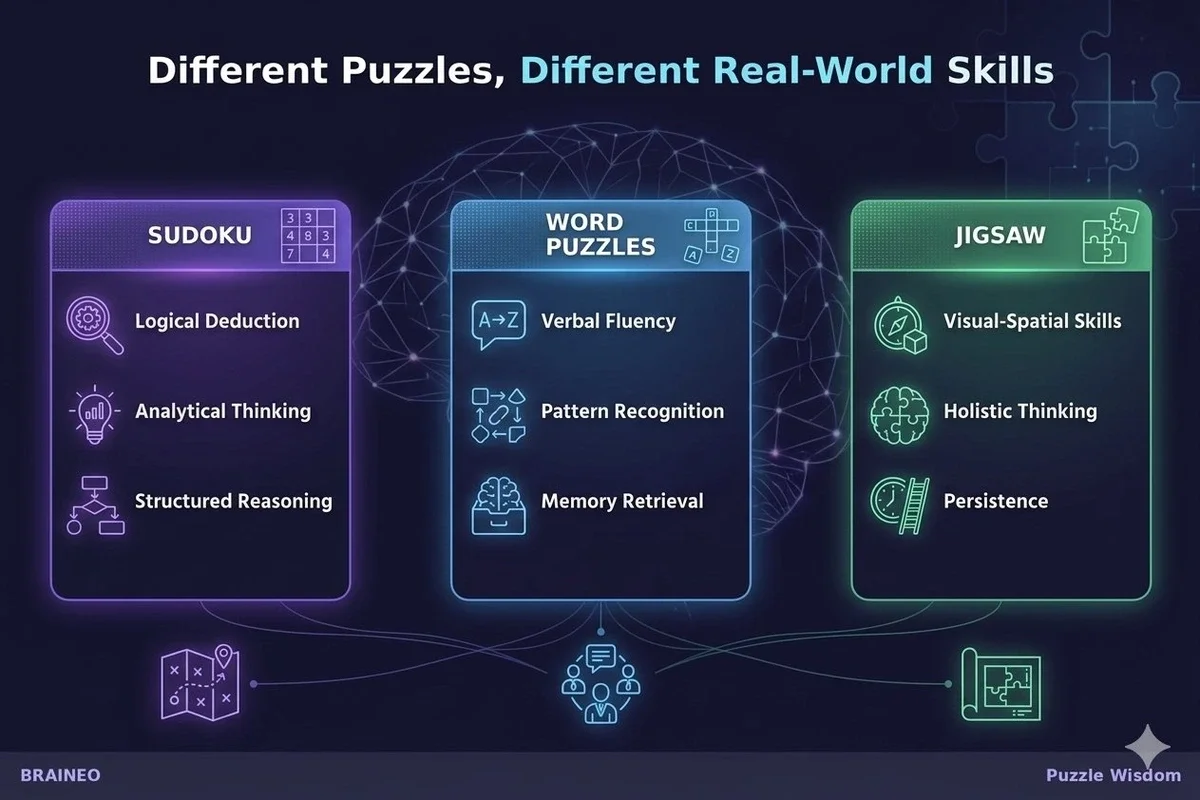
Different puzzles train different parts of the brain, together building a complete set of transferable thinking skills.
Making Puzzles Part of a Thinking Practice
The most powerful aspect of puzzles as cognitive tools is their accessibility. You do not need a gym membership, a specialized piece of equipment, or a large block of time. A puzzle book and fifteen minutes of focused attention are enough to begin building habits of mind that carry real, measurable benefits into the rest of your day.
If you are looking for a structured place to begin, a well-designed puzzle book offers a clear progression from simpler challenges to more demanding ones, which means you are always working at the edge of your current ability, the cognitive sweet spot where real growth happens. Braineo's Sudoku and word puzzle collections are built around exactly this kind of structured difficulty progression, making them a natural starting point for anyone who wants to build a genuine daily puzzle practice.
The case for puzzles as real-world thinking tools is not built on optimism. It is built on a growing body of research that consistently finds the same thing: people who challenge their minds regularly through structured problem-solving become more adaptable, more persistent, and more capable thinkers. That capacity does not stay on the puzzle page. It follows you into every difficult conversation, complex decision, and new challenge that life presents.
FAQ
-
The research strongly supports the connection. Studies consistently show that regular engagement with logic puzzles, word games, and visual challenges develops cognitive flexibility, pattern recognition, and analytical thinking, all of which transfer into everyday decision-making and problem-solving. The benefits are not dramatic overnight changes but steady, compounding improvements in how the brain approaches difficulty.
-
Different puzzles train different skills, so variety is the most effective approach. Sudoku builds logical deduction and structured reasoning. Crosswords strengthen verbal thinking and memory retrieval. Jigsaw puzzles develop visual-spatial reasoning and the ability to see how parts relate to a whole. Mixing puzzle types gives your brain a more complete cognitive workout and builds a broader range of transferable skills.
-
Consistency matters more than session length. Even three to five sessions per week, each lasting fifteen to thirty minutes, can meaningfully strengthen cognitive habits over time. The key is regularity, approaching puzzles as a daily mental practice rather than an occasional activity.
-
Puzzle-driven thinking skills develop across the full lifespan. Children build foundational reasoning and persistence through puzzles. Adults strengthen the executive function and analytical skills they use at work and in complex personal decisions. Older adults maintain cognitive flexibility and problem-solving ability that supports independent, sharp thinking well into later life.
-
Frustration is actually a natural and useful part of the process. The discomfort of being stuck is precisely where the brain is being asked to adapt and find a new approach, which is exactly the kind of mental training that builds real cognitive resilience. Taking a short break and returning with fresh eyes is a completely valid strategy, and the persistence you develop by working through difficulty is itself one of the most transferable skills puzzles can build.